The Artistic Sardine in Vancouver
Script by Jay Zhuang
“White Cube” – as one of the most renowned galleries in Britain – is also a term implying spaces and galleries in the context of contemporary art. Canton-sardine’s naming partly derived from a Neo-Realist show whose invitation letter, titled Full-up, was a sardine can full of handwritten texts, while Canton refers to its locality of being in the centre of Chinatown – historically made up of Immigrants from Southern China. To replace the word “space” with “Sardine”, Steven determines to emphasize the institute as an independent and artist-run space.
Steven Dragonn, graduated from the Sculpture Department of Guangzhou Academy and later from the Film and Multimedia Arts Department of Université de Paris-Est, France, had years of experience in both curatorial and artistic practices. He immigrated to Vancouver years ago and established Canton-sardine in 2018, under the principle of producing high-quality shows faithful to his own artistic standard. He has expanded his influence via a series of published works, curated shows, and Youtube videos, gradually garnering widespread recognition in the mainstream circle.
Canton-sardine exhibited a diversity of shows, ranging from exploring feminism in the practice of AI arts, the representation of memory from East Germany, and also Chinese immigrants from the 19th century in British Columbia. Themes like personal identity, memory, conceptual art have been across shows in the recent years. For nearly two years, Steven has co-hosted a weekly podcast about contemporary art on Youtube with his close friend, Yang Xiaoyan, a renowned curator and art critic from China, and the channel has gained a steady increase of subscribers and reached out to a bigger pool of audiences. Today we have Steven here to talk about his curatorial and artistic practices implicated in Canton-sardine. (S: 72 Dragons Arts C: Canton-sardine )
S: Why did you decide to establish Canton-sardine? Isn’t it quite rare that we see Chinese-run galleries in Vancouver?
C: Vancouver has a good vibe for art. We all know many artists like Emily Carr are from Vancouver; each year many art graduates are out of UBC and ECUAD as well. Rudimentary-level artists in Vancouver are quite vibrant. In fact, there are not too few Chinese-run galleries in Vancouver. The founder of Bau-xi Gallery, Bau-Xi Paul Wong, as early as in the 60s, already planned to introduce Canadian artists to the world but, due to racial discrimination, Canada didn’t want this role played by a Chinese Canadian, so Paul experienced some difficulty at that time. My friend, Steven Tong, who is managing CSA Space located on the Main street, is quite an individual I respect greatly. He never got trained in art school, but learned everything by himself. His Space is similar to the renowned Borges Bookstore in Guangzhou. Overall, there are actually still quite some art spaces run by Chinese in Vancouver.

“No.223(Lin Zhipeng): Satellite of Love” curated by Kelvin Yiqun Huang & Steven Dragonn, 2020, selected in Capture Photography Festival 2020
S: Why did you establish the Institute in Chinatown?
C: The rent is cheap. The building we’re in now was restructured by the government which later rented the units out for artist-run centers and artist studios. Mostly they are artist studios but my space is an artist-run center, not a commercial gallery.
S: Since you have extensive experience working in both China and Canada, can you tell us what the differences are in terms of working method in these two different cultures.
C: When working in China, we usually got no more than two or three months to prepare for each exhibition in spite of the massive scope of some big projects. Now, in Canada, I have two or three years to prepare for each show. If you want to collaborate with me, you may have to wait until 2025. On the other hand, the pace of working is relatively slower in Canada, and you can’t make changes at the last minute. I remember when I was doing shows in China, in the last hour before the opening kicked off, I could still print something out and put it into the show. That’s unimaginable to most westerners, I think.
S: In terms of the content you’ve worked on, what are the differences then?
C: There is no such a relevant criterion for comparison. The Museum I worked on in China were mostly about traditional art, its aesthetic nature heavily leaned toward Chinese paintings. In Vancouver, I only want to work on shows I want to do, and think about what sort of institute I want to run here. The characteristics of the works are fundamentally different.
S: I noticed that you’ve covered a variety of shows with largely distinctive themes in recent years. How would you position Canton-sardine as an art space in Vancouver?
C: I’m only working on two or three out of totally five or six shows we’re exhibiting each year. In the future I’ll collaborate more frequently with other curators. Overall, We’re a very new institute, and, for the first three years in the business, we’re simply aiming to stay alive ( GIGGLING ). The goal is to remain sturdy and robust in the business for the first five years. I’m not gonna set a strict guideline on what I should or should not do, but I also need to stick to my artistic practice. In previous shows, the main task was to find the artists that matched with my curatorial style. When I’m investing for shows, I don’t wanna get bullshit from others. Making art, making friends with artists, seeing two dimensional works blended nicely into a three dimensional space – these are quite fun to play around with.

“Gu Xiong: The Remains of A Journey” curated by Henry Heng Lu & Steven Dragonn, in collaboration with Centre A, 2020, the exhibition granted by Canada council for the Arts, BC Arts council & City of Vancouver.
S: There are already quite a few exhibitions focused on Asian-oriented issues. As one of the minority groups, Asian artists tended to highlight its unique identity in the backdrop of North America with many elements closely tied to identity politics. I don’t see such an explicit element in the shows you have presented.
C: Then I have to ask what your definition is for “Identity politics”?
S: Well, I think. It’s based upon a presupposed perspective of examining political affairs through racial and de-colonial critical theories.
C: Identity politics could be categorized as two types, one as a generic criticism against existent structure and the other as more narrow-minded. Some artists demonstrate their stances clearly in works while others do it in a much subtle way. In previous exhibitions, as you can see, the artists mostly have deep reflections on their personal identity, but they didn’t use that as a sort of shield or a card they played. For example, our inaugural exhibitor, He Lixiao, also graduated from Guangzhou Academy of Fine Art, has consistently done performance art pieces implicated with personal identities. His works are similar to Li Binyuan’s works but not as intense as his. Guxiong, from Vancouver, has always worked on issues related to immigration, international labor, as we could see from his solo exhibition, “The Remains of a Journey”, in which he explored the early history of Chinese immigrants in the 19th century. This is also about Identity. Moreover, Wang Qingsong’s Photography, though not explicitly associated with personal identity, reveals his identification with the lower-class population. If you’ve followed him online, you would know he has always tried to present the magic-realist side of the marginalized population in society. From an artist’s oeuvre, you can see what sort of stances they take.
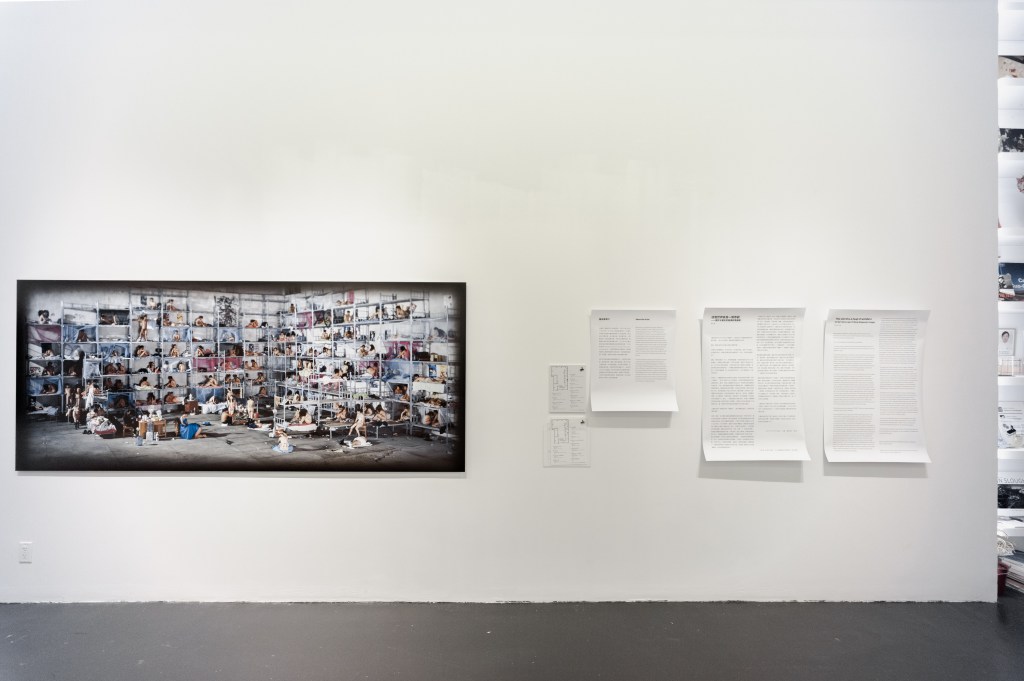
”Qingsong Wang: FOTOFEST” curated by Xiaoyan Yang & Steven Dragonn, 2021, selected in Capture Photography Festival 2021 & Winner of Printing Prize.
S: I’m also curious about how you’ll position the institute within the art circle in the future? What kinds of shows and artists would you like to exhibit? I feel like you’re trying to demonstrate the other side of Asian artists rarely depicted in the mainstream. In my limited experience, when seeing shows by Asian artists, they tended to play the identity card. In a way, it’s a form of intellectual laziness.
C: Well, for me, I tend to care about problems with a deeper root. I have seen so many works by others via different mediums, and thus I know that some are very straightforward with their stances through their works. In fact, I still make art. Now I’m working on video installations and conceptual arts. I personally care more about the depth and breadth in artistic expression. Form, of course, is important but it has to merge nicely with content. This is what is important to me. In terms of the future, I’m just tiptoeing myself through streams of challenge. I don’t know if I can gain recognition but at least I’m not like a stone lying soundlessly on the bottom of the ocean.
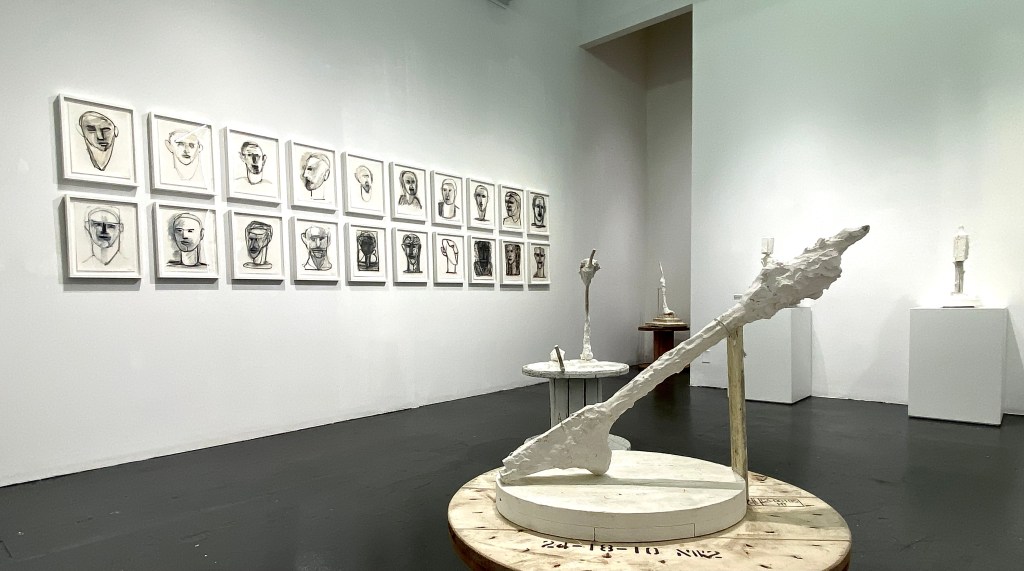
“Pierre Coupey +Dion Kliner: Imaginary Portrait” curated by Lam Wong, 2021
C: There was a saying in the business as I was working in China. Exhibition is like fireworks.
S: A sparkling chasm passing across the sky
C: Yeah. No one will remember your show. The point is to have fun and enjoy your time. For the openings, the key, when I was in China, was to have a big crowd, like a wedding, you know.
S: As you’ve mentioned, your space currently remains non-profit. Would you consider getting into art collection and establishing relationships with potential clients as a way of exploring something new?
C: In terms of staying as a nonprofit or transitioning to the commercial mode, I remain open for both scenarios because each has respective merits. If you want to make your institute more popular, being exposed to a bigger pool of audience, then, of course, we gotta make the space commercial. But for me, things are still at their early stage. I’m not in a hurry. Let’s see.
S: Can you elaborate on the drawbacks and merits of these two business models?
C: If you’re working running a nonprofit institute, you need a board, a professional framework that includes all the councils and board members and lay out positions like the Board of Director, Curator, Chairman, etc. Hundreds of thousands are spent on maintaining this bureaucratic structure. And you gotta do fundraising each year and file your applications to different levels of government each year. The money is not a free lunch. You need to apply and you may not get it at the end. I know, some institutes have run on such a model for decades, but their businesses aren’t easy either. They also go through ups and downs, but the good thing is that they aren’t gonna disappear suddenly and they can keep the business running as long-term institutes. The other problem, in addition, is that who gets to be the director of the institute has a direct impact on how the space will evolve. If I follow this business model, the control over the institute, at the end, may not be in my hand, because the Board and the Director have different responsibilities.
S: Then what’s the biggest difficulty for you to run this institute now?
C: First, my family isn’t quite well-off. Advertising, promoting and curating the shows, even making videos are all done by myself. When I made up my mind running this institute, the first question I asked myself was if I could do all the tasks by myself. I applied for government-led funds as well, but, in Canada, the system is quite bizarre. If they cover your operational cost, then they wouldn’t cover your exhibition costs.

From Left to Right: Vancouver based legendary artist Michael Morris, Curator Lam Wong, Artist and professor at UBC Gu Xiong, Steven Dragonn
S: In fact, You have created a mini ecosystem that includes exhibition, publication, and art talks uploaded on your Youtube Channel.
C: To be honest, we stepped into Youtube via a stroke of luck. At the beginning of 2020, Mr. Yang gave us a talk, “From Figurative to Abstract”, in our own space, and we recorded it because it was quite informative. Mr. Yang agreed to put it on Youtube as I suggested. We always talk carefreely from mornings to evenings. Later we decided to put all these conversations online. It was when the pandemic started, everyone stuck at home, and then we’ve gotta this going since then.
S: What’s the most important thing when running an institute like that?
C: Actually, when running a gallery, the key is to maintain its reputation. For example, when travellers come back home from Vancouver, if asked by their friends if they’ve visited our gallery, then, to some extent, it means that the gallery has somewhat represented the city. And the other thing is that – a consensus I have with Mr. Yang – we never ever do one single shit show. I don’t dare to say our exhibitions in the past were great but I can say it affirmatively that with the limited resources I don’t have any regrets with the shows we’ve done. As long as you’ve exhibited one shit show, you are over because people do remember that!
-Published in Chinese on 72 Dragon Arts Artblog, Shenzhen, China, 2022
 Steven Dragonn