Contemporary Local Landscapes in the Tide of Globalization
By Steven Dragonn, 2023
Globalization is a “dangerous” topic. While we embrace the globalization movement for the convenience and superiority it brings to individual lives through its infinite leverage of social and economic prosperity, a small fraction of people persist in reflecting on and criticizing the homogenization or convergence driven by consumerist models that gradually erode the diversity of social structures. They employ various methods to remind the public that humanity’s most proud and superior trait—individuality through diversity—is being squeezed and continuously suppressed on a macro level. This group naturally includes artists, who, through visual media, provide their observations on this phenomenon, initially proposed in the 1960s by French philosopher, Marxist, and filmmaker Guy Debord in his theory of The Society of the Spectacle (La Société du Spectacle). These observations are expressed in various forms, aiming to reconstruct our understanding of the societies we inhabit.
Focusing on this discourse, I have selected works by two artists who primarily practice in visual media for analysis and discussion: Chinese artist Weng Fen and Canadian artist Jeff Wall. Both are globally renowned figures in the art world. Interestingly, their works were exhibited side by side at the group show Between Here and There: Passages in Contemporary Photography at the Metropolitan Museum of Art in New York in 2010.

View from the exhibition “Between Here and There: Passages in Contemporary Photography”, Weng Feng and Jeff Wall’s works exhibited side by side, Metropolitan Museum of Art, New York, USA, 2011.
The exhibition featured Weng Fen’s 2002 photograph Riding the Wall – Haikou (5) from his well-known Riding the Wall Series. In this series, Weng constructs composite scenes featuring one or more young women climbing walls to observe the emerging urban landscapes. They seem uninterested in entering the scenery beyond but rather sit on the wall gazing into the distance. The term “riding the wall” thus became synonymous with Weng’s name. Although the series captures various urban landscapes across China, Weng began in his hometown of Haikou, Hainan Island, before extending to other locations.
As Riding the Wall gained attention, Weng expanded on its core theme of “wild watching.” The subjects transitioned from young women to family members, tourists, or local villagers, while the observers’ positions shifted from sitting on walls to standing on platforms, mountain tops, or open spaces. The observed landscapes also evolved, ranging from cities to mountains, coastlines, fields, or construction projects.
To the audience, this theme may appear as an exploration of spatial dimensions, but simultaneously, Weng quietly focuses on the temporal changes in his hometown of Hainan. In 2022, he revealed this underlying motif through two exhibitions: The Vanishing Landscape in Vancouver and Listening to the Waves in Taishan Village in Shunde. These exhibitions combined his years of field research and observation into immersive viewing experiences, akin to watching sand pass through an hourglass. In interviews with Xiaoyan Yang and me, Weng emphasized the phenomena reflected by the island’s locality under the dimensions of globalization. These phenomena or factors are suspended within his works, leaving an open space for audience reflection.

Riding the Wall – Haikou (5), Weng Fen, 2002

The Vanishing Landscape – The Fishermen’s Village Near My Home Turned into a Commercial Complex, Weng Fen, 2021

Disappearing Landscapes, view from Weng Fen’s solo exhibition in Canton-sardine, Vancouver, Canada, 2022

Listening to the Waves in Taishan Village, view from Weng Fen’s solo exhibition in Boxes Art Museum, Shunde, Guangdong, 2022
On the other side of the globe, Jeff Wall, an artist born and raised in Vancouver, Canada, is renowned for his large-format lightbox “cinematographic photography.” His works often reconstruct scenes he has witnessed, experienced, or extracted from literature. Wall highlights the hidden or overlooked marginalized aspects of urban life, whether people, landscapes, or objects. While his works do not explicitly depict specific features of Vancouver, most of his creations are shot and produced there, directly or indirectly tied to the city. In an interview, Wall said: “Any place can represent every place. I realize Vancouver is just as good as anywhere, though I believe there are more spectacular and interesting cities. But regardless, it is entirely sufficient.”
This underscores Vancouver as an example of both locality and globalization. His small solo exhibition, Views In and Out of Vancouver, held in early 2023 at Canton-sardine, strongly affirmed this connection. The exhibition introduction (co-written by the artist) stated:
“Jeff Wall has been engaged in photographic creation for fifty years, exploring various themes and perspectives. These themes and perspectives persistently pursue real-time observation of the spaces and behaviors of contemporary life. Amid often unsettling yet sometimes exhilarating complexities, they continuously revolve around the cityscape of Vancouver, gaining worldwide recognition. However, many of these issues have remained unseen in this city over the years.”

Rainfilled Suitcase, Jeff Wall, 2001
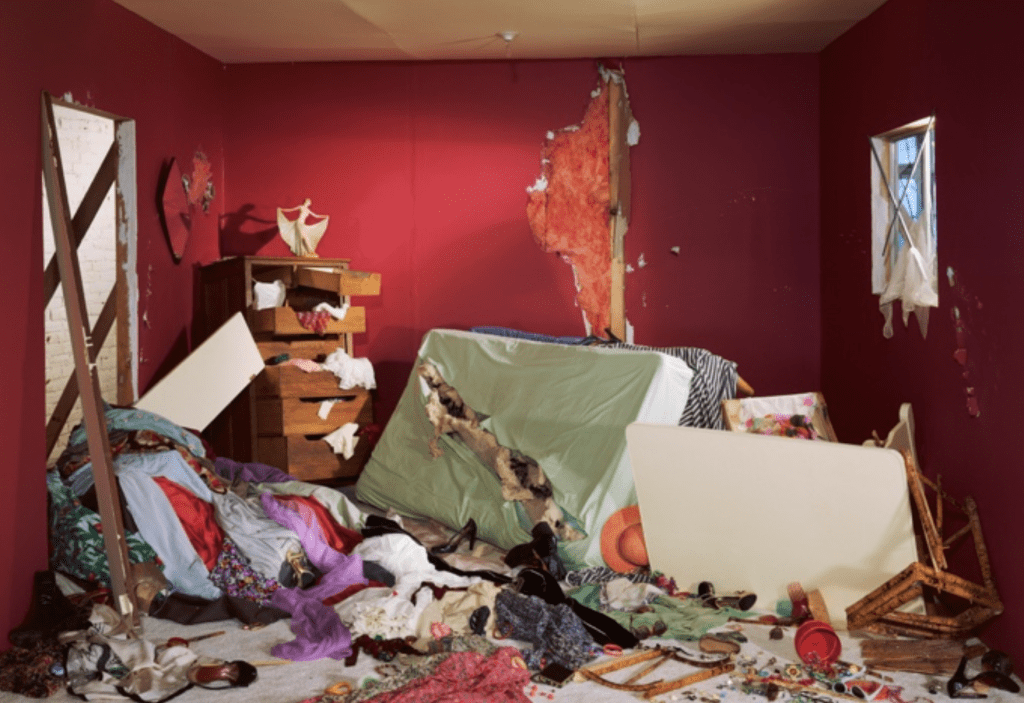
The Destroyed Room, Jeff Wall, 1978

The Old Prison, Jeff Wall, 1987
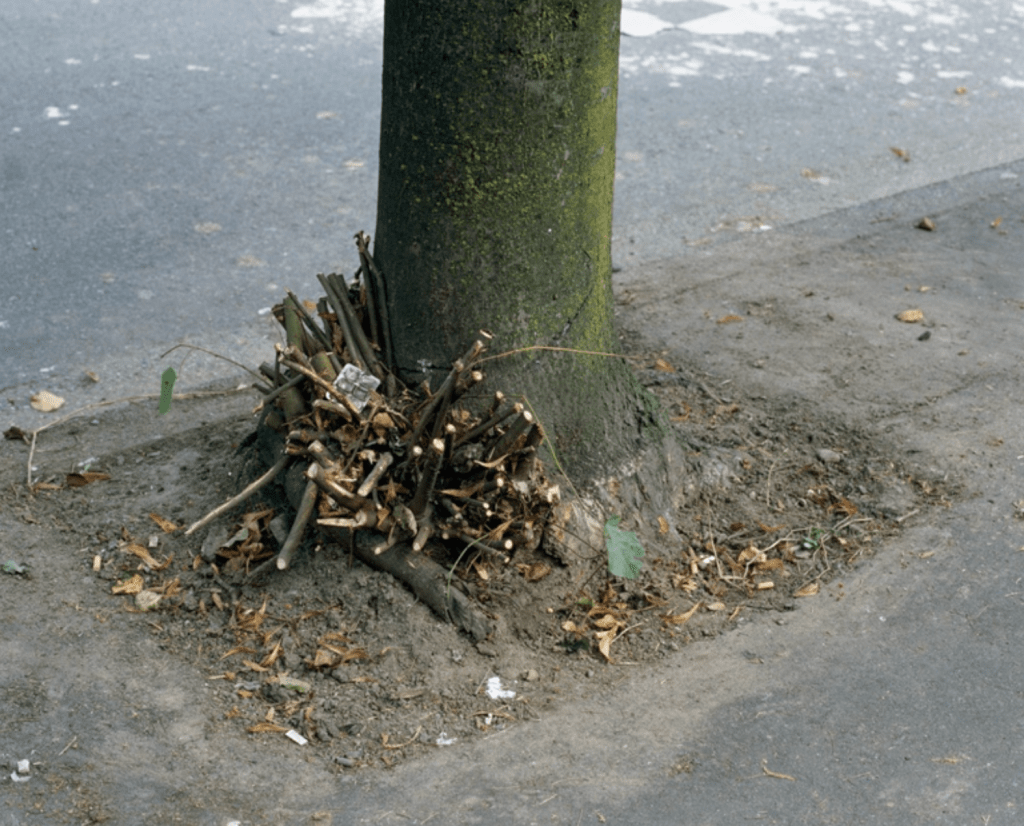
Clipped Branches, East Cordova Street, Jeff Wall, 1999

Cuttings, Jeff Wall, 2001
Both Weng Fen and Jeff Wall share several commonalities: They embed existentialism and phenomenology in their works. They focus on specific environments as objects of scrutiny, whether or not explicitly portrayed. Their works are open-ended, inviting the audience to uncover meaning rather than offering definitive conclusions. Both artists address issues of local marginalized groups. Their art critiques the dynamics of power and discourse in silence. Both are products of extended observation over time (Weng’s over 20 years of Hainan; Wall’s over 50 years of Vancouver).
Interestingly, while one focuses on Hainan Island—located at the southernmost edge of China—and the other on Vancouver—a corner of North America’s west coast—both places, geographically and culturally, are seemingly inconspicuous, even insignificant. Yet through the relentless efforts of these two artists, the landscapes and struggles of these cities have been vividly presented to the world.
Globalization appears to be an unstoppable trend. But what have we lost in the process? Or rather, what seemingly insignificant yet potentially precious aspects—once sources of pride—are being eroded under the weight of this overwhelming tide? Perhaps these are the very questions posed by these two artists.
 Steven Dragonn