The Countryside: How Did It Suddenly Become a Battleground Between Global Culture and Pristine Ecology?
By Steven Dragonn, December 2018
As the inaugural Meishan Land Art Festival draws to a close, I finally “gather the courage” to complete this long-overdue article. Reflecting on the past six months spent frantically making an art festival miraculously land successfully in a place in Chengdu, China—neither remote nor convenient, where even couriers won’t deliver—I feel immense gratitude. My first and sincere thanks go to the organizers, the OCT Sino-French Agri-Science and Technology Park, and FangSuo. Without their relentless efforts, this art festival could never have taken place.
In the art or cultural world, we often discuss how globalization impacts local culture. Yet most of these effects aren’t directly visible, hence the need for academic discourse. If they were obvious, there would be no need to discuss them. This time, however, I experienced firsthand the direct impact of globalization.
If we disregard other factors to purely discuss the artistic nature of the works, I think it’s meaningless. Artists wouldn’t agree with such curators either. When discussing art, politics influences art; when discussing politics, economics influences politics; when discussing economics, agriculture impacts economics; and when discussing agriculture, technology influences agriculture. And when we talk about technology, art, in turn, influences technology. We’re likely no longer discussing a singular topic but an entire interconnected information system.
The Meishan Lanf Art Festival finds itself in such a state—whether in terms of time or space. Observing from an outsider’s perspective, I often see two completely different results.
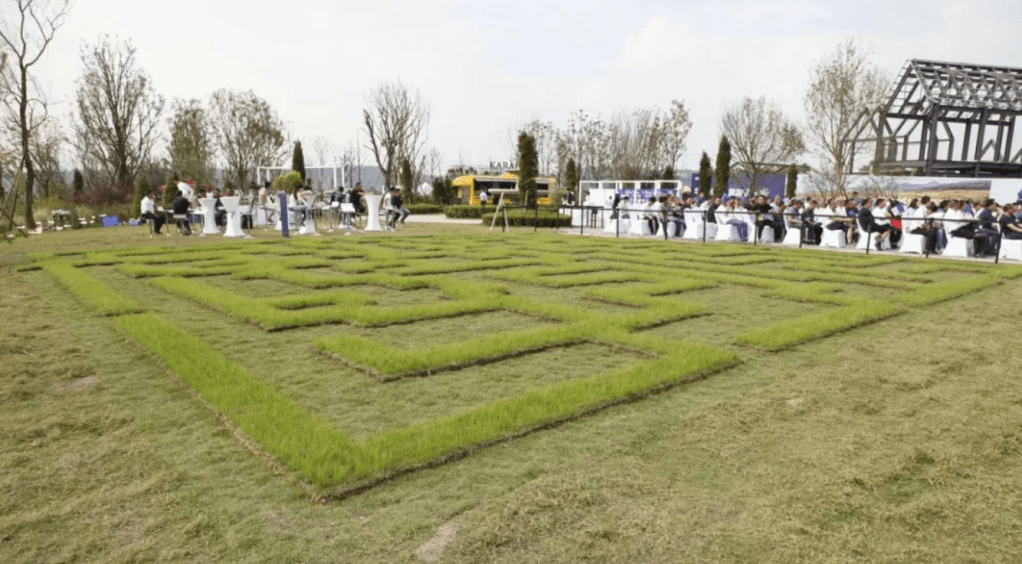
Mixed Team (Fan Bo & Luo Peng), “Game Tunnel”, Interactive installation, plants, 20m x 20m, 2018
The Sino-French Agri-Science and Technology Park seeks to boost rural development through a new agricultural economic model. This ideology naturally attracted the involvement of French techniques, leading to the appearance of French elements. Thus, a French-style garden seemingly “fell from the sky” in Meishan, a spot neither too close nor too far from Chengdu.
As the festival’s chief curator Xiaoyan Yang said, “When I first visited the site six months ago, it was a strange field rapidly undergoing demolition and redevelopment. I wondered, ‘Can we even make this happen here?’” Surprisingly, this French-style garden materialized within just two months.
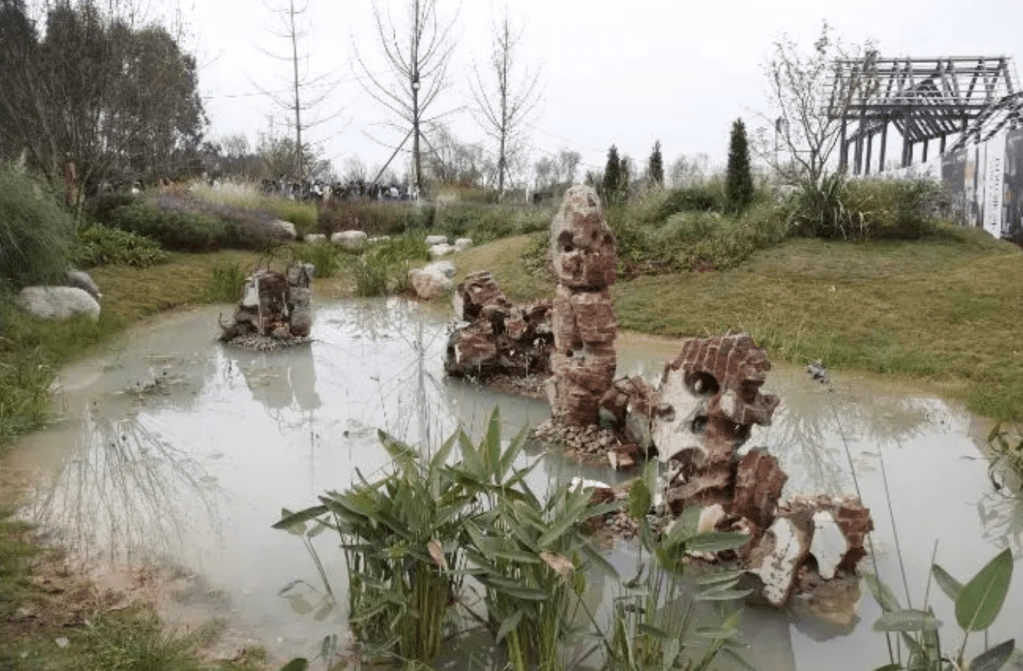
Jinsong Shi, “Garden of Thousand Creations”, Sculptural installation, red bricks, metal, and architectural debris, Variable dimensions, 2018
Some scholars find it odd for China to adopt Western forms instead of promoting its traditional styles. They argue it doesn’t align with contemporary Chinese identity. However, for local residents, this novelty is a delightful event. Does creating pseudo-Chinese antiques offer a better alternative? Faced with such ideological confrontations, I found myself hesitating for the first time.
What is globalization? While criticizing urban development and lifestyle homogenization worldwide, we must not overlook the exotic transplantation method, which has existed since colonial times and remains popular today.
Be it the mysterious Orient in Western eyes or the noble ideal of Western modernization for the East, distinguishing good from bad becomes increasingly blurred in our flattened world. No such comparison seems necessary either.
China, as one of globalization’s most active advocates, harbors deep aspirations to “embrace the world,” regardless of how intellectuals critique or negate such approaches.
Under such strong societal contexts, the appearance of French-style elements in rural China is merely another symptom of globalization. As Liu Jianhua’s work “Extraterritorial Object” aptly points out, these “objects” reflect this phenomenon.
From certain perspectives, the rural economic model inspired by this new style resembles a rebranded land reform movement. However, local communities welcome such transformations, seeing them as more practical compared to laboring on farms to produce goods that barely sell.

Jianhua Liu, “Extraterritorial Object”, Sculpture, painted stainless steel and laser lights, 8m (H), 2018
Amid controversies surrounding this model, I hesitated again. Take Fabien Veyron’s reflective totem pole “Wherever I May Roam,” Zhongwang Fu’s “Grafted Seeds,” Do they reflect untouched ecology or human intervention? It’s hard to tell, and harder to articulate.
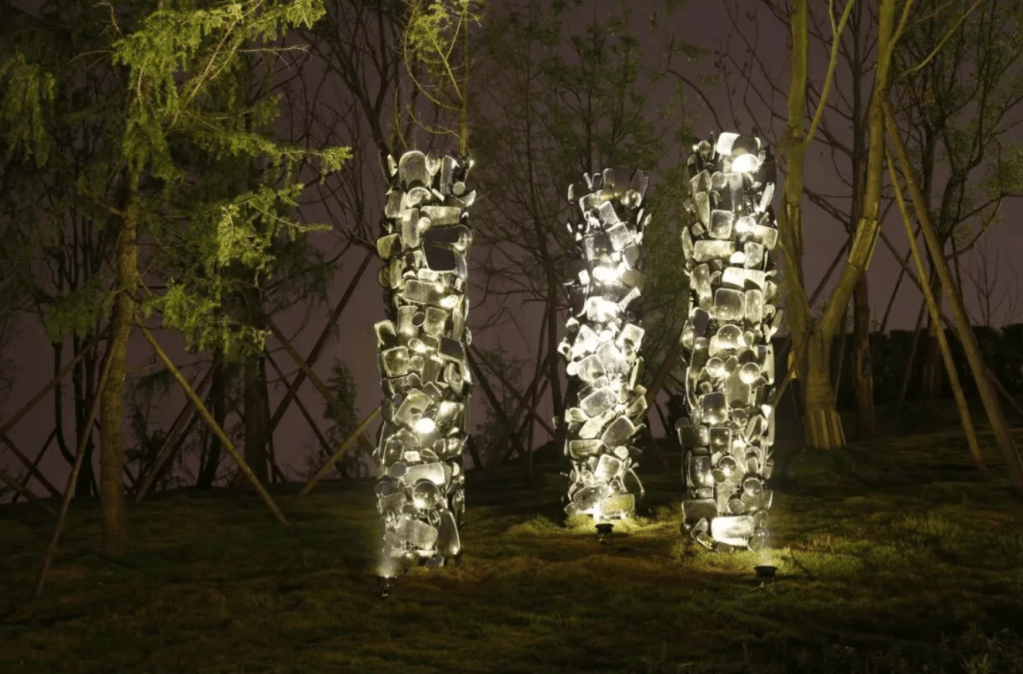
Fabien Veyron (France), “Wherever I May Roam” (Night View), Sculpture, glass, plastic, metal, 2.5m-3m (H), variable dimensions, 2018
Likewise, perhaps in the eyes of the public, or even capital, art may merely play a minor role in grabbing attention. Stunning visual impacts and poetic undertones are sufficient to achieve their goals, even if artists with a sense of mission aim for more. Art thus becomes a disruptor in this battleground—a third party outside the realms of capital and power. In this swirling vortex, it appears to make some difference, yet at the same time, no difference at all. Art forms a “peculiar” relationship, acting as a mediator between opposing forces.
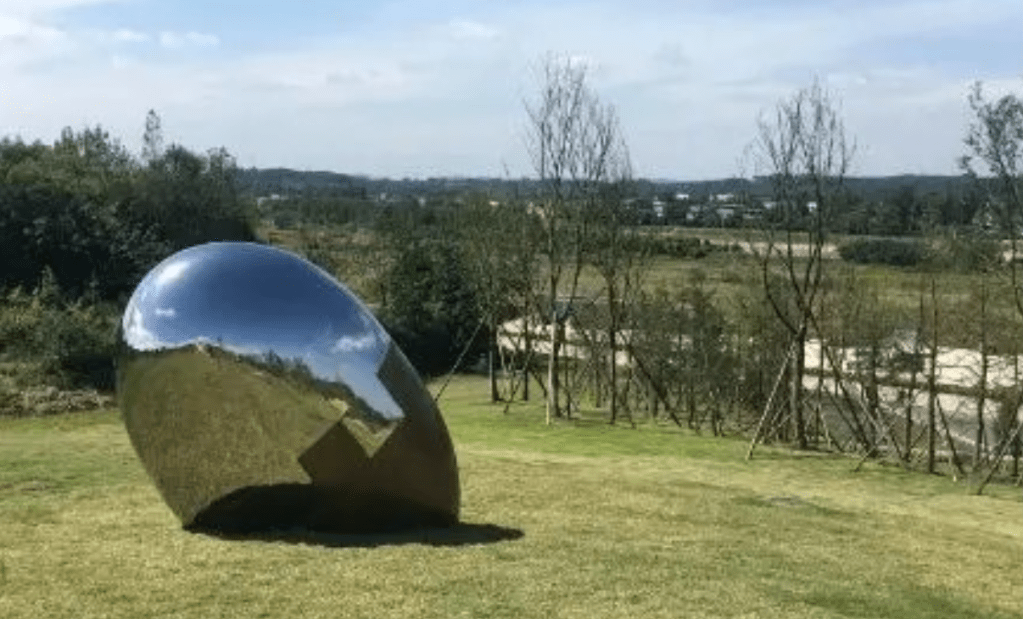
Zhongwang Fu, “Grafted Seeds”, Sculpture, copper and stainless steel, 3m (H) x 4.5m (L) x 4.5m (W), 2018
For us, whether as artists or curators, upholding certain values is crucial. Facing powerful external forces should not lead to boundless compromises. This is a dynamic process, akin to practicing Tai Chi—leveraging minimal force to redirect larger energies, using external strengths to interact with societal developments and changes.
Speaking of disruptors, the protection of intellectual property—art being a form of knowledge production—has made me feel unexpectedly “respected” in China. When intellectual property becomes a weapon, it instills fear in everyone.
As land art served as the foundation for this project, it turned into something akin to “He-Who-Must-Not-Be-Named” from Harry Potter—an unspeakable concept. From the artists’ perspective, beyond being comically absurd, this also reflects a globalized issue.
What we once believed to be an intellectual property battle confined to the tech world—where profit is directly generated—has now extended to the cultural realm. Even if the original problem didn’t exist, we now face it head-on. Land art, viewed by the art world as a concept emerging in the 1970s, somehow became patented by certain nations or individuals. Even more absurdly, they’ve adopted “Chinese characteristics” to handle “Chinese problems.” After witnessing this, all I can say is that I’m truly “astonished.”

Pierre Picard (France), “Sound Tunnel: Between Paris and Tianfu”, Multimedia installation, mixed materials, Diameter: 1.5m, multiple pieces, 2018
It’s sad to see “patriotic defenders” rally against cultural exchanges over something as trivial as “chopsticks holding spaghetti,” shocking their opponents into submission. Similarly, during the “Meng Wanzhou incident,” nationalist fervor scared others into silence. Compared to these two cases, does art matter at all? Is it worth speaking up for? Faced with such stark contrasts, I hesitated once more.
I’ve discussed many topics seemingly unrelated to art, yet these issues are precisely reflected in the works themselves. As the public appreciates this visual feast, they’re also witnessing a contest of global cultures.

Xiong Gu (Canada), “Born from Water” (Night View), Installation, compressed air, 500 acrylic boats, variable dimensions, 2018
As I mentioned earlier, this battleground isn’t merely a clash between Western culture, represented by French aesthetics, and Eastern culture, represented by China. Instead, it encompasses conflicts within social movements, critiques of consumerism, and struggles between elite and popular cultures.
Take Yiming Wang’s “Five-Colored Flags” and its underlying environmental activism, which highlights how environmentalism has moved beyond slogans to become part of societal action. Xingtao Jiao’s “Crawling Form” bluntly critiques consumerism. Jinsong Shi’s “Garden of Thousand Creations,” built from ruins and placed within the Monet Garden, creates a complex context of confrontation between old and new, Chinese and Western elite cultures. Julien de Casabianca’s “Out of the Museum” uses street collage to critique traditional aestheticism.
Meanwhile, works like Sam Lam’s “Chili Peppers,” Philippe Colin’s “Dream Cage,” Xiong Gu’s “Born from Water,” Pierre Picard’s “Sound Tunnel,” and the Mixed Team’s “Game Tunnel” reflect on the relationship between humans and nature from various angles. These works particularly emphasize social dimensions.
These pieces qualify as contemporary art, in my opinion, because they genuinely reflect current societal conditions and provoke deep thought.
Finally, let me again quote curator Xiaoyan Yang:
“In a sense, we all live within a giant network—or more vividly, a massive enigma. We’re moving forward, practicing, and compromising. Including curation, we pursue ideals and goals, but we emphasize practice as an opportunity to push boundaries. What can art become? This is a societal question—something neither artists, curators, critics, nor even government officials or state enterprises can solve single-handedly. Therefore, I emphasize the importance of practice and the opportunities it presents. Through these opportunities, we can attempt, encourage, and push progress as far as possible. Doing something is better than doing nothing; having capital willing to invest is better than having no investment at all.”
This article was published on Mookmeart Online Magazine (in Chinese), 2019
Further Readings
- Poetic Ubiety: Meishan Land Art Festival Set to Open Soon, Art China Exhibition announcement (Chinese, Sept 27, 2018) https://mp.weixin.qq.com/s/TAGMBiNZuQ1TWb7N7MtMJA
- The 18 Square Kilometers Where Contemporary Art Reaches Become the Realm of Poetry, Hi Art Journalism Feature (Chinese, Sept 30, 2018 ) https://mp.weixin.qq.com/s/7qWb0nFSkX1nR1EHCdtHsg
- “What Can Art Become?” – Meishan Land Art Festival Critics & Artists Symposium, ArtCanCanArt Journalism Feature (Chinese, Nov 27, 2018) https://mp.weixin.qq.com/s/jMz3AWfuwKJioZf4Z2p5DA
- The Countryside: A Place Full of Infinite Possibilities, Art Commerce Journalism Feature (Chinese, Dec 27, 2018) https://mp.weixin.qq.com/s/UgRu2MQHtRqMJVtNtgVr-Q
- Introduction video on Youtube https://youtu.be/veeQox8mtX8
 Steven Dragonn