Artist Steven Dragonn’s Solo Debut: Art That Endures Is Art That Stirs the Soul
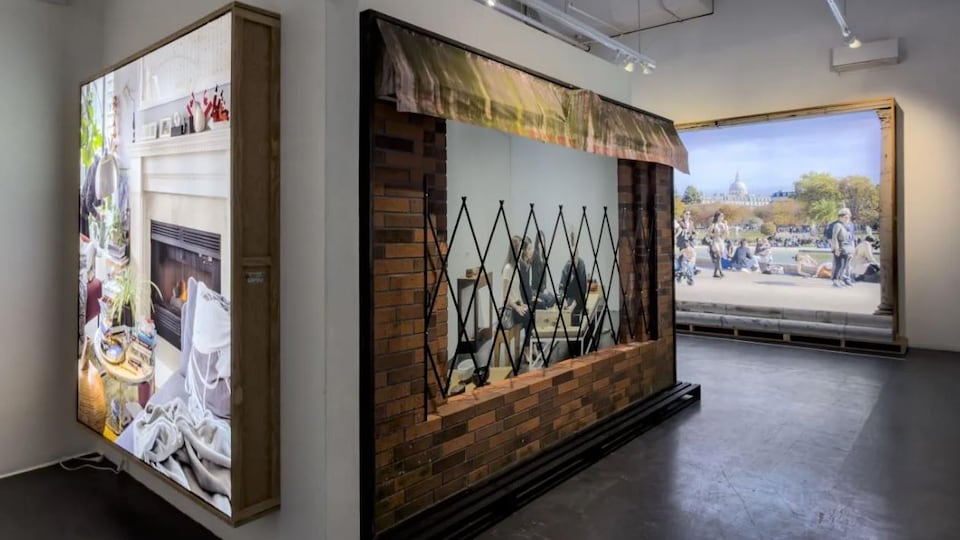
Title Image: Chinese artist Steven Dragonn’s first solo exhibition, Vancouver May Never Be Poetics Between Montparnasse and Mongkok, is currently on display. Photo: RADIO-CANADA / STEVEN DRAGONN / CANTON-SARDINE
By Yan Liang
Published: May 20, 2026 at 21:58
Vancouver-based artist Steven Dragonn’s inaugural solo exhibition, Vancouver May Never Be Poetics Between Montparnasse and Mongkok, is officially underway.
Curated by art critic Yang Xiaoyan, the exhibition features large-scale lightbox photography and installations. The body of work serves as an observation and record of the artist’s own immigration experience, the diaspora, personal identity, and loneliness.
In an exclusive interview with Radio-Canada Chinese, Dragonn shared that having lived in Vancouver for ten years, this milestone felt like the perfect moment to create a commemorative marker for himself. The featured works took several years to complete, representing a process of “slow creation.”
“I am expressing a certain emotion toward Vancouver. It is both a personal expression and something that carries a universal resonance. I have always believed that all art capable of enduring is art that stirs the soul and evokes a deep sense of empathy when people look at it.” — Steven Dragonn
As curator Yang Xiaoyan describes, the artwork begins with the everyday: a CD, a corner of a home, the spine of a book. Yet, within these precise details, the gaze turns inward—capturing a collision between vision and reflection, reality and fiction.
Dragonn graduated from the Sculpture Department of the Guangzhou Academy of Fine Arts and later studied film in France before ultimately settling in Vancouver. Over the years, he has also managed his own galleries, including Canton-Sardine and Neo-Space.
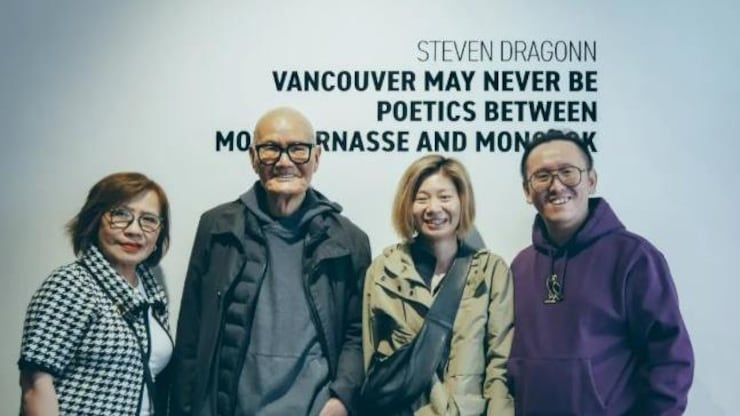
Image: Artist Steven Dragonn (right) alongside curator and artist Zheng Shengtian (second from left), artist Greta Ho (first from left), and Lynn Chen. Photo: RADIO-CANADA / STEVEN DRAGONN / CANTON-SARDINE
During an artist talk with Jo-Anne Birnie-Danzker, the former director of the Vancouver Art Gallery, Dragonn revealed that pursuing art is a luxury. However, for an artist, it is also something inseparable from life that demands perseverance. To sustain his gallery and his creative practice, he relies on working as a food delivery driver, teaching, and working on construction sites to support his daily life.
This solo exhibition received funding support from the Canada Council for the Arts and is featured as part of the Capture Photography Festival’s Selected Exhibitions program.
The Influence of Jeff Wall
Dragonn’s pieces employ staged setups akin to cinematic scenes, utilizing meticulous details, light, shadow, and framing to tell a story—evoking the style of the renowned Canadian photographic artist Jeff Wall.
During the 1990s and early 2000s, an entire generation of staged-photography artists emerged, elevating the meticulously crafted, cinematic photographic methods of Cindy Sherman and Jeff Wall to a grander, technologically advanced scale.
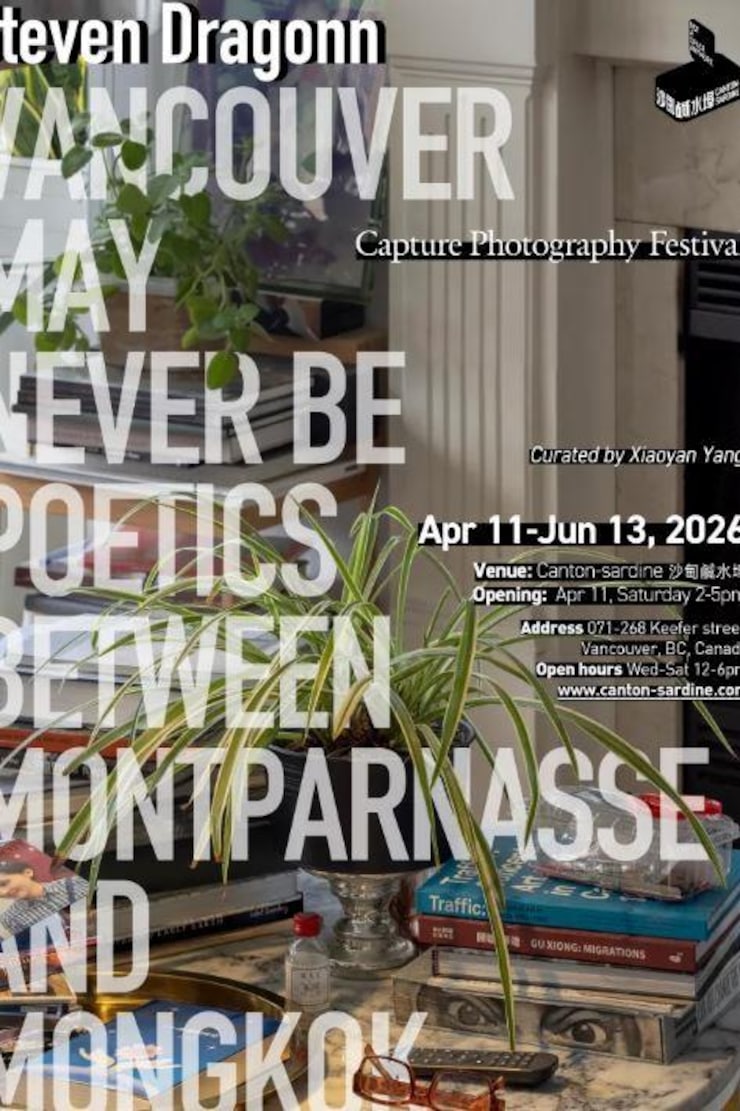
Image: The poster for the current exhibition. Photo: RADIO-CANADA / STEVEN DRAGONN / CANTON-SARDINE
Dragonn stated that these works do not mean he is permanently fixed to this specific creative medium, noting that he also creates video art. This exhibition represents just a fragment of his work, which may gradually evolve into different forms over time.
“Jeff Wall’s creative approach has existed for nearly fifty years now, and all of his works have been thoroughly analyzed and studied,” Dragonn noted.
Dragonn himself is highly interested in researching Jeff Wall. Throughout his research, he discovered many parallels: on one hand, the two share similar backgrounds, as both studied film but ultimately transitioned into art instead of making movies. Furthermore, Dragonn pays great attention to single-frame compositions and narrative imagery, and he is deeply fascinated by exquisite, large-format staged photography. Finally, there is the element of realism—a trait deeply rooted in, and inseparable from, his artistic training back in China.
“Since these elements are unavoidable, I felt I should just embrace them. Given that this method exists right there, I adopted it directly. I used it as a medium for my own expression, rather than copying or appropriating his work—I simply utilized his methodology as a vehicle.” — Steven Dragonn
Jeff Wall is widely regarded as one of Canada’s most influential and prestigious artists. His work is celebrated for breaking conventional notions of photography through staging and the meticulous manipulation and recombination of various pictorial elements, occasionally building directly upon historical paintings—a process he terms “cinematographic photography.” He was awarded the Hasselblad Award in 2002.
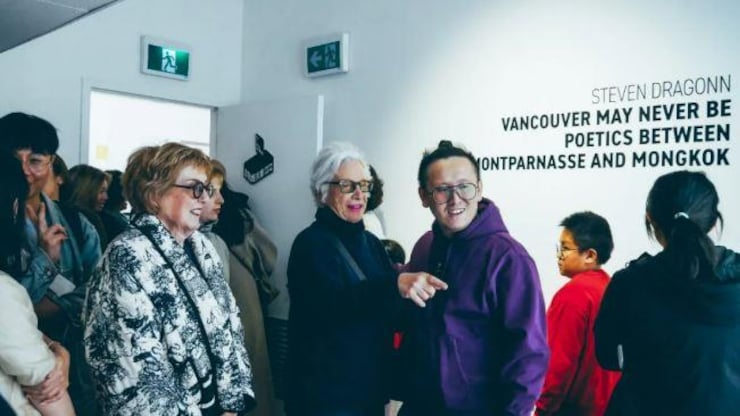
Image: The exhibition has drawn a considerable crowd of local artists and viewers. Photo: RADIO-CANADA / STEVEN DRAGONN / CANTON-SARDINE
In the Artist’s Words:
Vancouver May Never Be Poetics Between Montparnasse and Mongkok
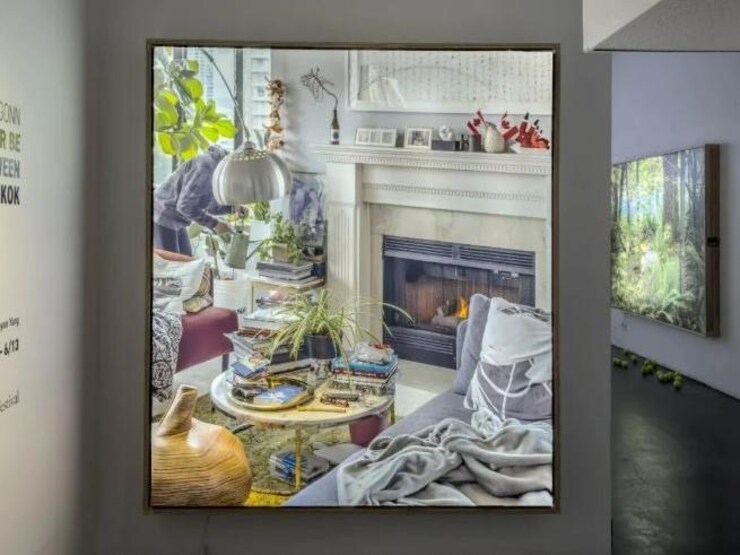
Image: The title piece of the exhibition: Vancouver May Never Be Poetics Between Montparnasse and Mongkok. Photo: RADIO-CANADA / STEVEN DRAGONN / CANTON-SARDINE
The title is borrowed from an album by an independent Hong Kong band, exploring the friction between a romanticized “elsewhere” and the reality of an arbitrarily designated destination. While the band’s lyrics imply that a French-style romance is an unattainable fiction within a crowded Hong Kong, my personal journey inverted this trajectory: chasing dreams in France, only to ultimately settle in Vancouver.
This serves as a metaphor for life’s paradoxes and cycles—a perpetual tug-of-war between who we are and where we physically find ourselves. As the opening piece of the series A Place Called Home, it confronts the foundational question of the overseas Chinese diaspora: Where is my true home? Within a culture that views “home” as a sacred, foundational cornerstone value, this work examines the shifting soil of belonging in an era of global mobility.
Let’s Heal the Divide
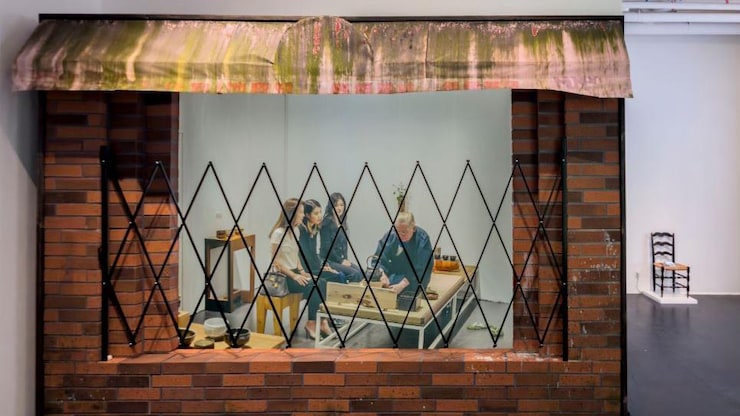
Image: One of the featured works, titled Let’s Heal the Divide. Photo: RADIO-CANADA / STEVEN DRAGONN / CANTON-SARDINE
The title is taken from a public neon art installation on the facade of a historic building in Chinatown, used here to examine the divergence between external perception and internal identity. Today, Chinatown is undergoing a transformation—evolving from what was once an essential safe haven into a cultural hub constructed around artists and exoticized urban experiences.
To me, Chinatown remains a symbol of isolation and conservative ideology; under the Western gaze, it challenges the very definition of authentic culture.
As a new immigrant, I do not inherently belong to Chinatown, yet because of my ethnicity, it is taken for granted that I share a connection with it. Quebecers speak French, yet they deny being French; Argentines speak Spanish, but do not identify as Spanish; native English speakers span the globe, yet they are not British. Only the Chinese people and Chinese culture possess an incredibly powerful centripetal will, perhaps originating from a long, uninterrupted history of grand unification.
In a broader context, this artwork explores the definition and identity of the Chinese diaspora, probing the symbols of cultural dislocation—where individuals are automatically presumed to inhabit specific spaces purely by virtue of their inherited ethnic lineage.
If You Are Lucky Enough to Have Lived in Paris as a Young Man, Then Wherever You Go for the Rest of Your Life, It Stays with You, for Paris Is a Moveable Feast…

Image: One of the featured works: If You Are Lucky Enough to Have Lived in Paris as a Young Man, Then Wherever You Go for the Rest of Your Life, It Stays with You, for Paris Is a Moveable Feast… Photo: RADIO-CANADA / STEVEN DRAGONN / CANTON-SARDINE
This piece acts as a map of obsession, tracing a trajectory from the peak of romance to quiet, introspective scrutiny.
I borrow Ernest Hemingway’s famous prose as a mirror to examine those Parisian years that continue to occupy the mind long after physical ties have severed.
The Luxembourg Garden and the Panthéon are no longer just places I walked past during my student days; they have transformed into totems of a past life, carried with me like a “moveable feast”—sometimes a gift, and at other times, a burden.
I attempt to question the boundary between an authentic cultural identity and an illusory, beautiful mirage. This work continues the dialogue on cultural dislocation that I initiated in Vancouver May Never Be Poetics Between Montparnasse and Mongkok.
Original Post Link: https://ici.radio-canada.ca/rci/zh-hant/%E6%96%B0%E9%97%BB/2255573/%E9%BE%99%E9%82%83%E6%B4%8B-%E4%B8%AA%E5%B1%95-%E6%91%84%E5%BD%B1%E8%89%BA%E6%9C%AF-%E6%B8%A9%E5%93%A5%E5%8D%8E

